Article: How Much Chlorine Granules Do I Need for My Pool?

How Much Chlorine Granules Do I Need for My Pool?
The amount of chlorine granules your pool needs depends on three things: its water volume, the increase in free chlorine required and the product's available chlorine strength. There is no single scoop size or daily amount that suits every pool.
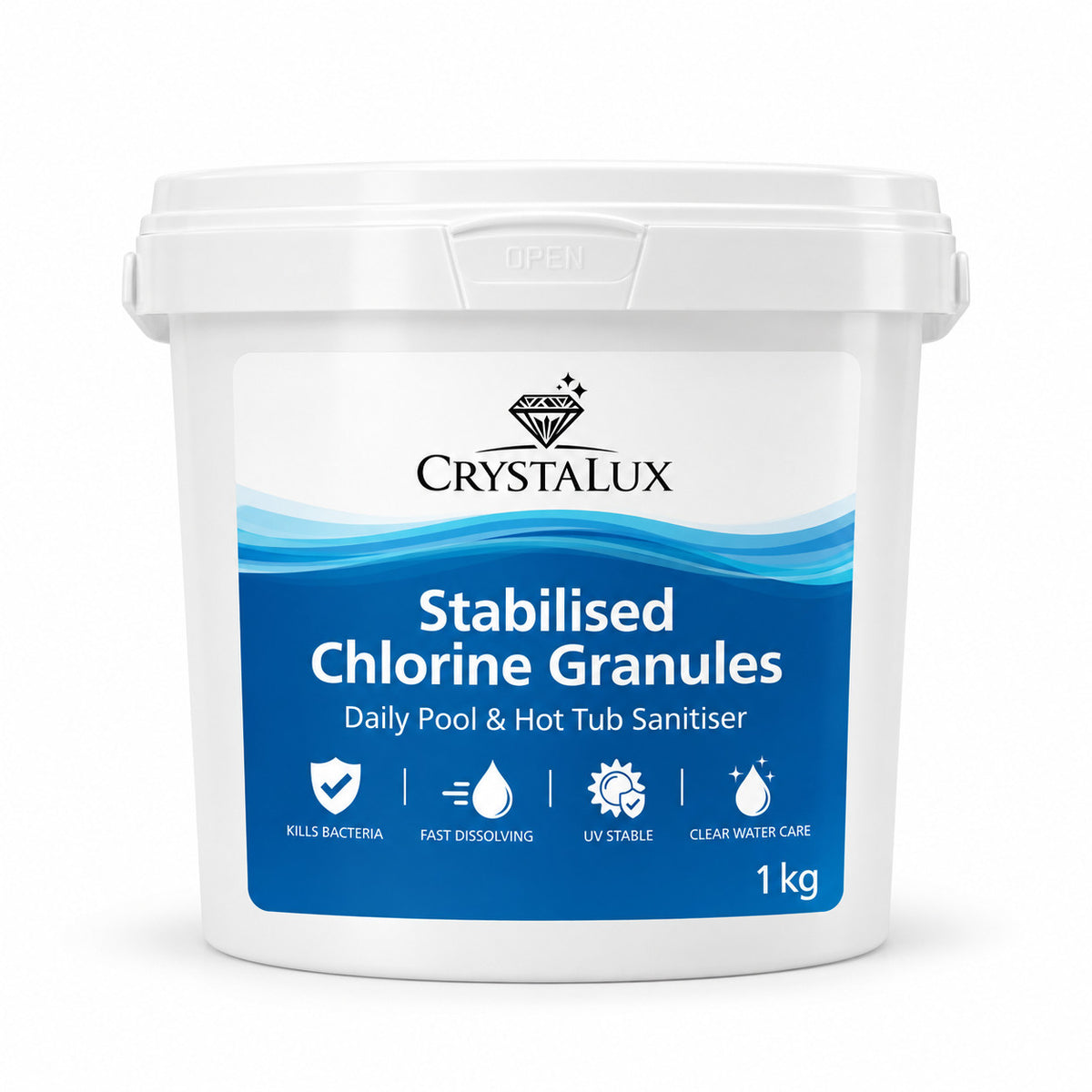
CrystaLux Stabilised Chlorine Granules are listed at approximately 56% available chlorine. At that strength, the theoretical amount to raise free chlorine by 1ppm in 1,000 litres is about 1.8g. This is a calculation estimate, not a substitute for the dosing instructions on your pack or a water test after treatment.
Check these before calculating a dose
- Confirm your pool volume in litres. Use its filled-water capacity, not just the maximum size on a box.
- Test free chlorine and pH. Use the target range specified for your pool and treatment programme. Check cyanuric acid (CYA) as part of that programme when using stabilised chlorine.
- Read the product label. Verify the available chlorine percentage, permitted use, application method and any dose limits.
- Work out the increase needed. Subtract the measured free chlorine from the appropriate target. If the reading is already at or above the target, do not add more merely because it is your usual dosing time.
For help with the arithmetic, use our pool and hot tub chemical dosage calculator. Select the correct chemical and use your own readings.
A worked pool example
Suppose a 10,000-litre pool reads 1ppm free chlorine and its treatment instructions call for a target of 3ppm. The required increase is 2ppm. For granules with 56% available chlorine:
Estimated grams = water volume in litres × required increase in ppm ÷ 560.
So 10,000 × 2 ÷ 560 = approximately 35.7g. Follow the product label for the actual dose and how to measure and apply it. The 3ppm target in this example is not a universal recommendation for every pool or hot tub.
Reference amounts for a 1ppm increase
The table below uses 56% available chlorine and assumes no chlorine is consumed during the calculation. It is not a daily dosing schedule, a shock-treatment table or a promise of the reading after application.
| Pool volume | Calculated granules for +1ppm |
|---|---|
| 1,000 litres | About 1.8g |
| 2,000 litres | About 3.6g |
| 5,000 litres | About 8.9g |
| 10,000 litres | About 17.9g |
| 20,000 litres | About 35.7g |
| 50,000 litres | About 89.3g |
Do not use these figures for a product with a different strength. If the label gives a different dose or rounding instruction, follow it. Contamination and other chlorine demand can make the measured increase smaller than the theoretical one.
Measure, apply, circulate and retest
Measure by weight using suitable equipment reserved for pool chemicals. Do not estimate grams with a kitchen teaspoon. Wear the protection stated on the label and keep swimmers out during treatment.
Only pre-dissolve granules when the label directs you to do so. If instructed, add the chemical to water, never water to the chemical. Never combine different chemicals, chlorine products or their solutions. Keep pH treatments separate and follow each product's application and circulation instructions.
Allow the specified circulation and waiting time, then retest. Swimming can resume only when the label's requirements are met and water readings are within the recommended ranges. Dissolved granules or clear-looking water alone do not establish that the pool is ready.
What if the chlorine reading stays low?
Do not repeatedly add the calculated amount without investigating. Confirm the volume and product strength, check that the test is suitable and in date, and look at circulation, debris and water balance. Unexpected zero readings can also need a test method suitable for higher chlorine levels, so follow your test-kit instructions.
Our low chlorine guide explains the checks. A pool needing recovery or shock treatment requires the appropriate label instructions, not an improvised multiple of this routine calculation.
Frequently asked questions
How often should I add chlorine granules?
Base additions on testing and your treatment instructions. Weather, bathing load and contamination change demand, so yesterday's dose is not automatically today's dose.
Does a 5kg tub need a different dose from a 1kg tub?
Not when they contain the same product at the same strength. Pack size is the quantity you buy. Our 1kg, 2kg and 5kg buying guide helps you choose how much to keep in stock.
Can I use this as a hot tub or shock-dosing chart?
No. This guide illustrates routine pool dose calculations. Hot tubs have their own treatment requirements, and shock treatments need product-specific directions. Follow the instructions for your equipment and chemical.
Buy granules for measured pool maintenance
If stabilised chlorine is appropriate for your water, choose CrystaLux Stabilised Chlorine Granules in 1kg, 2kg or 5kg. Unsure about stabilisation? Read our stabilised versus unstabilised chlorine guide before choosing.
Handling reference: CDC guidance on using pool chemicals safely. Always follow your product label.

Written by My Store Admin